


This edition is a bit more commercial than usual, so let me say it up front.
JumboTiger is my effort to help coliving companies become more agile and profitable, and in section 1 I am pitching that. I think it is wrong with how software gets sold to operators and where each product is not the right fit for you.
If that is not of interest to you, please skip to section 02. The news is still the news.
01 The build moment
In the last few months every other week an operator tells me that they are building their own PMS.
A founder opens Claude or Cursor on a Sunday. By Tuesday there is a booking flow, a tenant portal and a dashboard that looks better than most software they pay for. I know the feeling. I built BookMyColiving this way this summer.
The innovators are right about one thing. The vision now belongs to the operator, not the vendor. For ten years, software companies decided how your move-in worked, and you bent your operation to fit their forms. That era is ending.
But I have also watched what happens next.
The prototype takes a weekend. Production takes a year.
Rent that has to reconcile across gateways and currencies. A bed inside a room inside a building, each with its own lease and its own share of the electricity bill. Channel managers and smart locks that break on a Friday. And the pager on rent day at 2am.
The demo is the easy 20 percent. The other 80 percent is a year of edge cases on code only you understand.
So every traditional software company has the same question in front of it. Ignore the builders. Fight them. Or join them. We joined them. And as section 03 shows, we are not the only part of the stack that is moving.
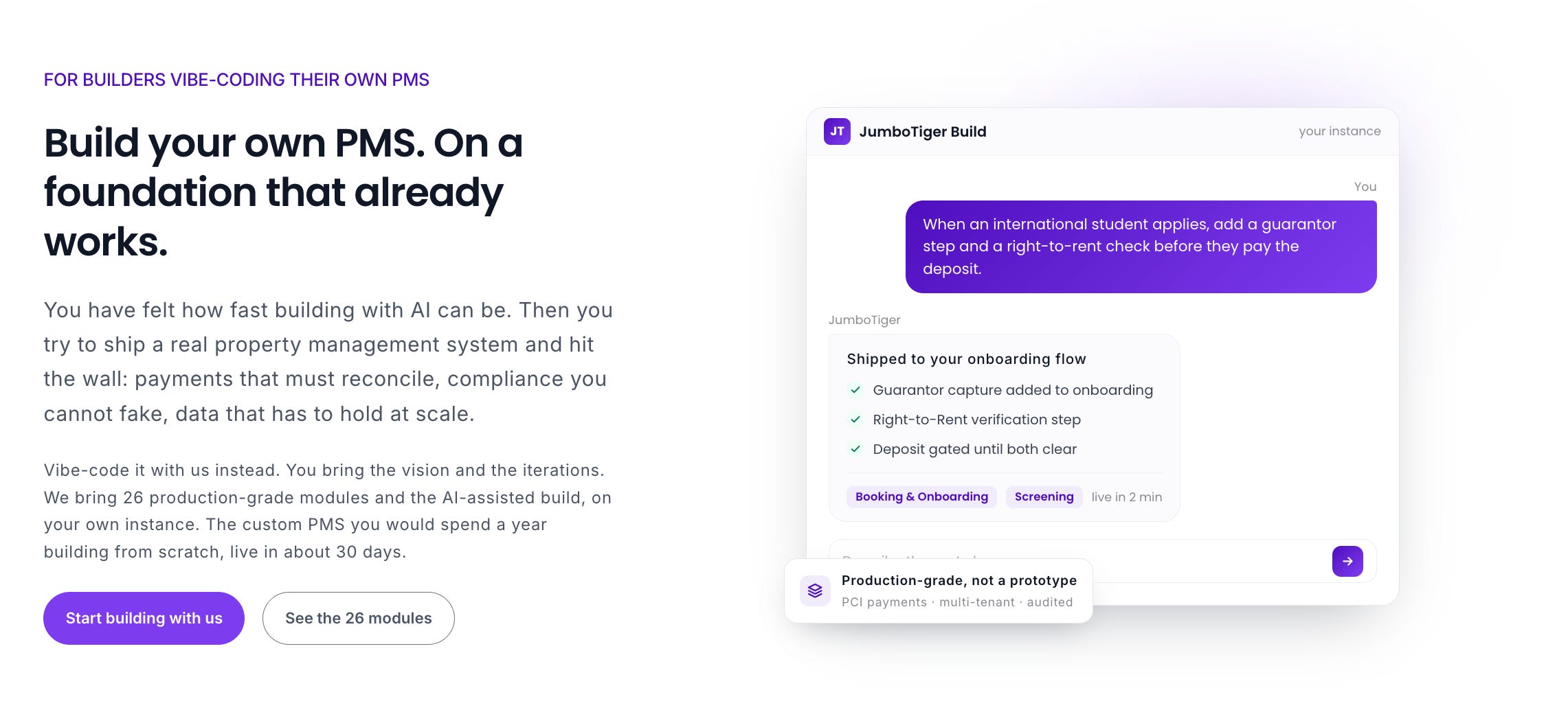
Build Your PMS on JumboTiger works like this:
You bring the vision. A call, a doc, a spreadsheet, a screen recording, or the prototype you already vibe-coded. That is your spec.
We assemble it from 26 production modules already running for real operators: booking, payments, per-bed inventory, maintenance, compliance, channel manager, owner portal and more.
It runs on your own instance. Not a seat in a shared SaaS product.
You describe a change in plain language. It ships as real, tested modules. The loop feels like vibe coding. The output is production.
We carry the payments, compliance, security and the maintenance tail.
Most operators go live in about 30 days, against the 12 to 18 months a serious from-scratch build takes.
Here is the honest version of who this is for.
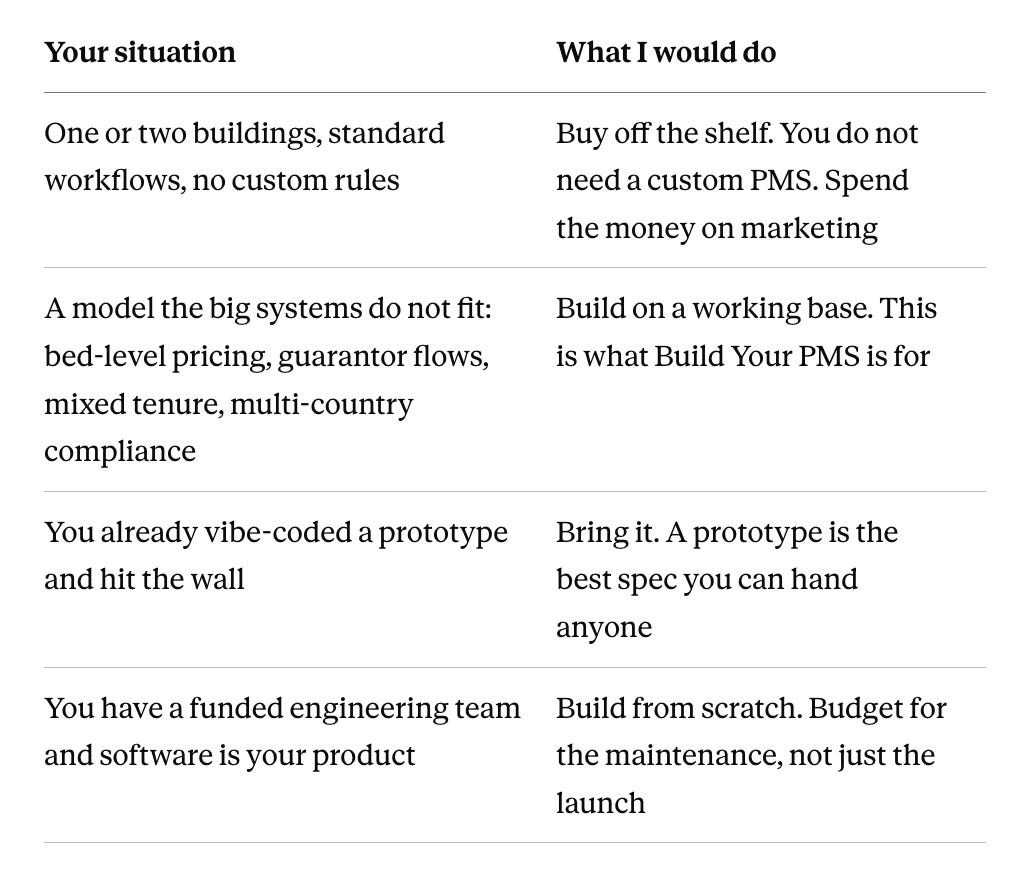
If you are in rows two or three, see how Build Your PMS works, or book 30 minutes and bring whatever you have started. You can also browse the 26 modules or read the case studies first.
02 Coliving Around the World
Bengaluru: The court just made compliance a data problem.
In a 10 September order, the Karnataka High Court set sweeping safety rules for paying guest accommodation across Bengaluru. The Greater Bengaluru Authority told the court that of roughly 5,000 PGs inspected in Bengaluru East, about 2,500 were running without proper licenses, sanctioned plans or fire clearance. The rules include a minimum of 70 sq ft per occupant, no cameras in rooms or bathrooms, police-verified staff, and a consolidated enforcement protocol within six weeks. The court also suggested a single digital database of every PG in the city.
What it means: licensing is no longer a one-time form. It becomes continuous, risk-based inspection. If you cannot produce your trade license, fire certificate and staff verification in five minutes, you have a building at risk, not a paperwork gap. This is also the moment the market separates. A PG with Wi-Fi and a logo is still a PG. Enforcement will make that visible. If you want expiry tracking across every building, that is what the JumboTiger compliance module does.
Nottingham: first purpose-built co-living approved, on a thin margin.
Waterway House, 300 studios near the railway station, was approved on 23 September. It is the city’s first purpose-built co-living scheme, operated by VervLife. The developer cut 25 units to make the remaining studios larger under the council’s new co-living guidance. Councillors approved it before the Section 106 figure was settled, with almost £4 million in contributions still under negotiation. The developer said gilt yields have left the viability margin “incredibly tight.”
What it means: when the development margin is that thin, the operating cost line decides whether a scheme works. Every manual hour your team spends reconciling rent or chasing move-in documents shows up in the valuation. Opex per bed is now a planning argument, not just an ops metric.
Australia: winning on yields, losing on planning.
BDO’s Luke Mackintosh told The Urban Developer that co-living really only works in New South Wales, under the boarding-house pathway. In Victoria, developers are converting serviced-apartment permits, which cap stays at around three months. The model needs roughly nine.
What it means: same lesson I took to Canada in the last edition. Name it first. Until a state defines the product, every scheme is a workaround, and your software has to handle a different tenure rule in every jurisdiction.
Chicago: an institutional co-living asset goes to market.
Cushman & Wakefield is marketing Post Chicago: 421 beds, 126 units, built in 2023, and 97% occupied. Average rent per bed is about $1,620. The building mixes co-living rooms, traditional apartments and short-term rentals under one roof.
What it means: two things. Buyers now underwrite per bed, so your data needs to exist per bed. And mixed tenure in one building is one of the hardest problems a PMS can face. Nightly, monthly and by-the-bed in the same ledger breaks most off-the-shelf systems. Expect due diligence to ask for it.
Madrid: public money funds coliving for the first time.
La Razón reports Madrid is creating 300 public coliving places, the first time the format gets public financing. They are aimed at people living with a mild disability.
What it means: coliving is becoming a care and social-housing format, not just a lifestyle product. That is the same direction as the older-adults work in Canada. It also means new operator types, with care plans, support staff and reporting duties that no coliving PMS was designed for.
Bangkok: coworking floors become homes.
Asset World Corp is converting space in The Empire tower from coworking to co-living, according to The Standard.
What it means: office-to-coliving is now a global play, not a London and Ottawa story. If you are weighing a conversion, our office-to-coliving guide is the place to start.
03 Rent just became something an agent can do
This week CasaPay published an MCP server for rent. It reads like a small technical release. I think it is one of the clearest signals yet of where rental software is heading. I wrote the long version on the blog: CasaPay Launched an MCP Server for Rent, and It Changes Everything. Here is the short one.
What MCP is. The Model Context Protocol is a shared standard that lets AI agents use real tools instead of only talking about them. Think of it as a universal adapter between an assistant and the software that runs your business. Claude, ChatGPT, Cursor or your own in-house agent can call it in plain language, as one step inside a bigger task.
Until now, “AI for rent” mostly meant a chatbot bolted onto a dashboard. This is different. Collect this rent, offer this deposit option, chase this arrears: those become verbs an agent can run under permission, not screens a person clicks through.
Why rent suits it. Rent is repetitive and rule-bound, which is exactly what agents do well. It also has a hard layer underneath: money movement, verified identity, regulated obligations and recovery. A chatbot cannot fake that layer. It needs real rails.
One interface for the whole rent job. This is not just a payment link with an AI wrapper. Through one MCP, an agent or a human operator can reach payment links, tenant verification and KYC, deposit management, a payment guarantee, and reporting. Today most operators stitch that together from five vendors with five logins. Collapse it into one surface and the agent learns one system, not five.
What it changes for you as an operator:
Collections your agent runs while you supervise. Create the month’s rent checkouts, watch what clears, escalate what does not.
Verify, set the deposit and add a guarantee in one flow, instead of bouncing between a KYC vendor, a deposit scheme and an insurer.
An arrears copilot cheap enough to run on every small arrears, with a manager signing off.
Reports on demand. When one operator asked for a specific report, the answer was simply to point their agent at the MCP.
It is built with guardrails: scoped credentials per agent, spend limits, approval thresholds on anything sensitive, a full audit trail and a sandbox. The agent removes the chasing. It does not get free rein over client money.
Why this belongs in an edition about building your own PMS. The PMS market is splitting three ways. Legacy per-seat suites, losing value as AI erodes the seat. Operators building their own systems with AI-assisted coding. And a well-funded wave of fully agentic platforms where agents, not screens, run operations. None of the three wants to rebuild rent money movement. All three need it. A neutral rent rail with an MCP interface sits under every one of them the same way.
That is the same lesson I paid for at Harrington, where leading with no-deposit stalled a deal for four months and leading with a cheaper rent rail unblocked it. Your PMS is not your payment rail. Keep them separable. Whatever you build on top, the rent layer underneath can stay constant.
Three things to do now:
Get your rent stack agent-ready. Favour tools with structured, machine-readable operations and clean reconciliation over closed dashboards. Our rent collection and payments comparison lays out the options, CasaPay’s competitors included.
Own a real checkout on your own website. Tenants are starting to find homes by asking an assistant. An agent-operable checkout on your own site is what makes you bookable by that assistant, without handing the customer to a portal.
Start building clean tenant payment history. Every rent payment collected cleanly today becomes the verified, portable record that agents will use to shortlist tomorrow.
It is early, and the tooling will keep maturing. But I would rather you prepare now than read about your competitor doing it next year. Details on the product are on the CasaPay operators page.
04 From the Academy: five tests for any PMS
The Everything Coliving Academy is live. Twelve modules, 60 lessons, built on the twelve pillars of coliving. It is free, by invitation. Anyone can request a place and we reply within 24 to 48 hours.
This edition’s module is Apps and Technology: five lessons, about two and a half hours, covering the coliving tech stack, choosing a PMS, payments and access, the resident app, and automation. The principle running through it is simple. Technology should remove work, not add it.
Here is my short version of the demo test from the PMS lesson. Use it on any vendor. Use it on your own build too.
The bed move. Move a resident mid-month from Room 4, bed B to Room 7, bed A. Rent should prorate, the deposit should follow, and door access should switch. No manual steps.
The bill split. Split last month’s electricity across a room of four, where one resident left on the 12th. Show each share.
The messy money. Take a part payment. Then refund half a deposit with a cleaning deduction. Show me the ledger and the bank reconciliation.
The compliance view. Show every certificate and license expiring in the next 60 days, across every building.
The exit. Export everything. Residents, ledgers, and documents. One click, open format.
If a vendor asks to do any of these on a follow-up call, you have your answer.
The module’s capstone goes further: map every layer of your stack, the tool or person filling it today, your fallback when payments or access fail, and the one integration that removes the most manual re-entry from a move-in. Request access to the Academy. If you want hands-on help instead, there is PMS and technology consulting.
05 What I would do on Monday
If you are vibe-coding a PMS. Stop at the prototype. Run the five tests from section 04 against it. Whatever fails is your production gap. Bring it to us or bring it to anyone, but do not ship rent collection on weekend code.
If you run PGs or coliving in Bengaluru. Put your trade licence, sanctioned plan, fire clearance and staff police verification in one folder today. Measure every room against 70 sq ft per head. The inspection protocol is due within six weeks of the order.
If you are developing in the UK. Underwrite opex per bed honestly. Nottingham shows how little margin is left. Your operating model is part of your viability case now.
If you collect rent by hand every month. Read the MCP piece in section 03, then look at your rent stack and count how many logins it takes to collect, verify, protect, and report a deposit. That number is your cost of not being agent-ready.
If you are happy with your current PMS. Good. Run the five tests anyway before your next renewal. It costs you an hour.
If you want to learn this properly. Request a place in the Academy. It is free.
Corrections policy: if any figure or attribution here is wrong, email me and it will be corrected in the next edition with your name on it.
Mayank Pokharna, Everything Coliving. mayank@everythingcoliving.com