


Before the news
Some weeks rearrange you.
A few days ago, something happened that made me stop and look hard at how I spend my time. I won’t go into the details here. What matters is what it left behind: a clearer sense of what is worth my energy and what never was.
When something like that happens, you stop adding to your life and start subtracting. You look at every commitment and ask whether it still earns its place. Most of it does not.
Coliving taught me this long before I needed it. The first time you move into a shared house, you arrive with too much stuff. Within a month you realise what actually matters is a door that closes, a kitchen where someone says good morning, and people who notice if you don’t come down for dinner. Everything else is storage.
I am rebuilding my priorities the same way. Fewer things. Done properly. With people who notice. This edition reflects that. It is about the one thing I think matters most right now: getting governments to name what we do, so it can be built at scale.
What I told Canada?
On 15 September I opened a workshop for the CMHC Housing Solutions Lab, Sparking the Co-Living Market. It is an 18-month federal lab, now in its fourth of five phases. The room held federal housing officials, CMHC policy and risk teams, municipal planners from three cities, a credit union lender, and developers who have already built coliving in Canada.
The Lab is focused on older adults. That changed how I heard the brief. The team’s own framing was blunt: millions of Canadians now live alone, a large share of them are over 65, and renters carry roughly double the housing cost burden. Loneliness came up in almost every session they had run.
Nobody in that room needed convincing that the need is real. What they lacked was a map of what governments elsewhere did that actually worked.
So I gave them three words.
Name it. New South Wales defined coliving in 2021. At least six private rooms, a three-month minimum stay, managed shared space, and a named operator. No affordability mandate inside the definition. That stayed in a separate instrument for boarding houses. The definition did not create control. It created countability. Once the product had a name, lenders could compare it with other assets. Australia went from almost nothing to an institutional pipeline in a shallow capital market. The threshold matters more than people think. London set its floor at 50 rooms, and only institutional money could play. NSW set six, and small developers came in too. For a country with as many small municipalities as Canada, I argued for a low floor. The threshold you pick is your industrial policy.
Count it. Washington’s HB 1998 (2024) stopped local governments zoning coliving out where multifamily is already allowed. It removed parking minimums near transit. Then it went after the fee maths. When every bedroom is charged like an apartment, and every bedroom needs a parking stall, the project dies on arithmetic before anyone argues about ideology. One Canadian project in the Lab’s case studies spent eighteen months on two building code appeals just to prove its houses were dwelling units.
Finance it. The same project got a lower loan-to-cost than a comparable rental build. The gap came to hundreds of thousands in extra equity. The project was not riskier. It was uncategorised. Europe shows the other side. Around 165,000 operator-led beds now exist there, with cap rates in mature markets in the 4.5 to 6 percent range. That only happened after the sector had standard definitions and published performance data. I closed on Spain, because it is the cleanest natural experiment we have. Madrid is creating a shared-residence use class and the pipeline is growing. Barcelona and Catalonia layered on density rules and lease mandates, and the pipeline stalled. Same country. Opposite directions.
My ask fits on a sticky note. A federal definition with a small number of hard criteria. Per-bed metrics in fee, density and parking formulas. A CMHC pathway that treats the definition as underwritable and publishes the data. None of it needs new money.
The team then ran a Ritual Dissent exercise. Each group drafted a 2031 minister’s speech celebrating Canada passing 5,000 coliving units. I liked that. It forces you to write the future as if it already happened, and then defend it.
I have shared my sources with the Lab for wider distribution. If you are working on coliving policy anywhere, our State of Coliving hub holds the country research I drew on. It is open.
Last 2 weeks in Coliving.
The UK is still the loudest pipeline.
Lambeth approved Vauxhall Square: three towers, nearly 3,000 homes, co-living units and student beds across seven buildings, about £2bn in total (Construction Enquirer). Blue Coast Capital appointed HUB for two London schemes in Southwark and Tower Hamlets, 485 homes combined (Property Week). Re:shape lodged its third London application of the year, 522 co-living studios plus 87 social rent homes at Tottenham Hale (BENews).
Outside London it is patchier. Bath’s planning committee referred a co-living scheme to Government (BTR News). Peterborough approved one outright (BTR News). Handelsbanken signed £24.25m of sustainability-linked finance for Fitz & Knox, Cardiff’s first co-living scheme (Insider Media). An 813-home student and co-living site in Exeter went to market (Inside Housing).
Read together: London permissions at scale, regional councils still escalate. That is the definition gap I described to Canada, playing out in the market that supposedly solved it.
Singapore put the state’s name on it.
The SG Youth Plan co-living pilot drew strong registration interest for roughly 100 units, and it was raised in Parliament (CNA). Coliwoo opened a 380-room co-living resort in a former government chalet (Stacked Homes). EdgeProp called it a sector coming of age (EdgeProp). This is a state testing the product in public before it writes the rules. Canada could do the same.
Spain keeps splitting.
The Defence Ministry’s coliving for military personnel is being challenged at the Audiencia Nacional (Moncloa). Esplugues, next to Barcelona, is limiting coliving alongside tourist flats (Esplugues.digital). Catalonia keeps tightening. Madrid keeps building.
Capital is being picky, not absent.
Eika Asset Management walked away from a €17m co-living project in Riga and sold the site (Delfi). In Denver, a lender asked for a receiver on X Denver, a building marketed on coliving suites and coworking (Bisnow). Neither story is about demand. Both are about capital structure. You have heard me say this before. You will again.
The US keeps widening distribution.
PadSplit partnered with Vidle Housing to house travelling healthcare workers (Morningstar). My position that PadSplit is house sharing has not moved. The healthcare-worker channel is still a smart one.
Korea. Homes Company announced a 356-unit coliving complex in Seoul’s Dongdaemun (Seoul Economic Daily).
India. Aurus Luxury Managed Residences signed an MoU with Siban for a large managed-living project (Big News Network). A legal piece asked whether coliving fits under RERA, a statute written for sales (Vaquill). That is India’s version of the Canadian question. A product with no name gets forced into a law built for something else.
If you are selling or buying an operating coliving, Colivings for Sale is free to list and free to browse. No broker commission.
What I wrote for India
In August I contributed a chapter to the NOESIS report The Evolution of Co-Living: Market Dynamics and Investment Potential. It runs to 143 pages and is the most detailed India dataset I have seen.
My chapter is called The Years Between Two Homes. The argument is simple. Most of what gets called coliving in India is not coliving. A PG with Wi-Fi and a logo is still a PG. Coliving is defined by what it delivers in the years between leaving your parents’ home and building your own: privacy you control, community that is designed rather than accidental, and an operator accountable for both.
The numbers make the stakes clear. NOESIS puts demand at about 6.6 million beds against roughly 300,000 organised beds, under 5 percent penetration (report coverage).
India’s gap is not tenants. It is definition, then buildings. It is the same lesson I carried to Canada.
Where to be
We keep a running directory of coliving events worldwide. It now lists 77. Browse, filter, or submit your own for free: everythingcoliving.com/coliving-events-conferences

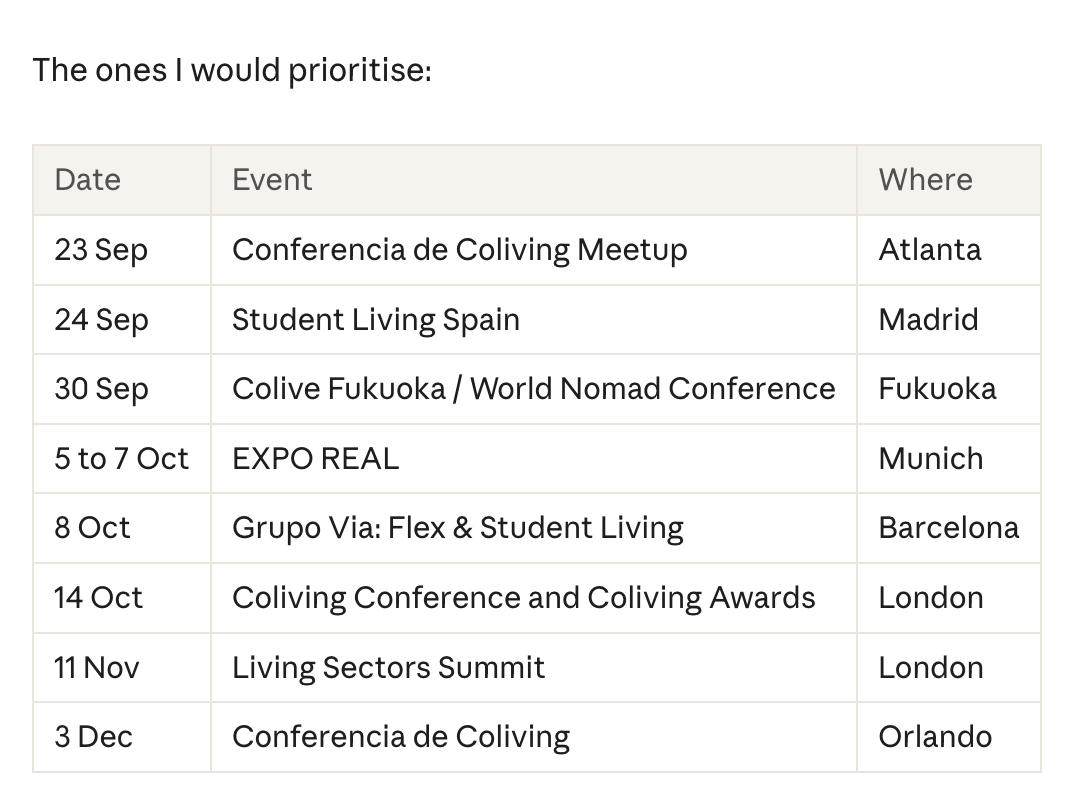
Organizing something we missed? Submit it. The listing is free.
Corrections policy: if any figure or attribution here is wrong, email me and it will be corrected in the next edition with your name on it.
Mayank Pokharna, Everything Coliving. Hit reply to reach me.