Things to Remember If You’re Starting or Running Your Coliving Business in 2026
Edition 84 | Everything Coliving Newsletter | March 2026

Hey everyone,
This one’s been brewing for a while.
Every week I get DMs from founders asking some version of the same question: “I want to start a coliving space; what should I know?” And every week I find myself writing longer and longer replies, pulling from conversations with operators across 20+ countries, news I’ve tracked, and mistakes I’ve watched people make in real time.
So I decided to put it all in one place. Consider this your 2026 survival guide, whether you’re launching your first 10-bed house or scaling to your fifth property across.
Let’s get into it.
[The Big Picture] Coliving Just Got Real
If you still think coliving is a niche experiment, you haven’t been paying attention.
Goldman Sachs acquired Urban Campus, the Madrid-headquartered operator managing €350 million in assets across France and Spain. This isn’t some VC playing around.
This is one of the world’s most powerful financial institutions saying: coliving is a legitimate real estate asset class.
Meanwhile, Colonies secured a €1 billion commitment from Ares Management for European expansion. Cohabs raised $450 million from institutional backers. Greystar and Bain Capital picked up three coliving communities in Spain for roughly €300 million.
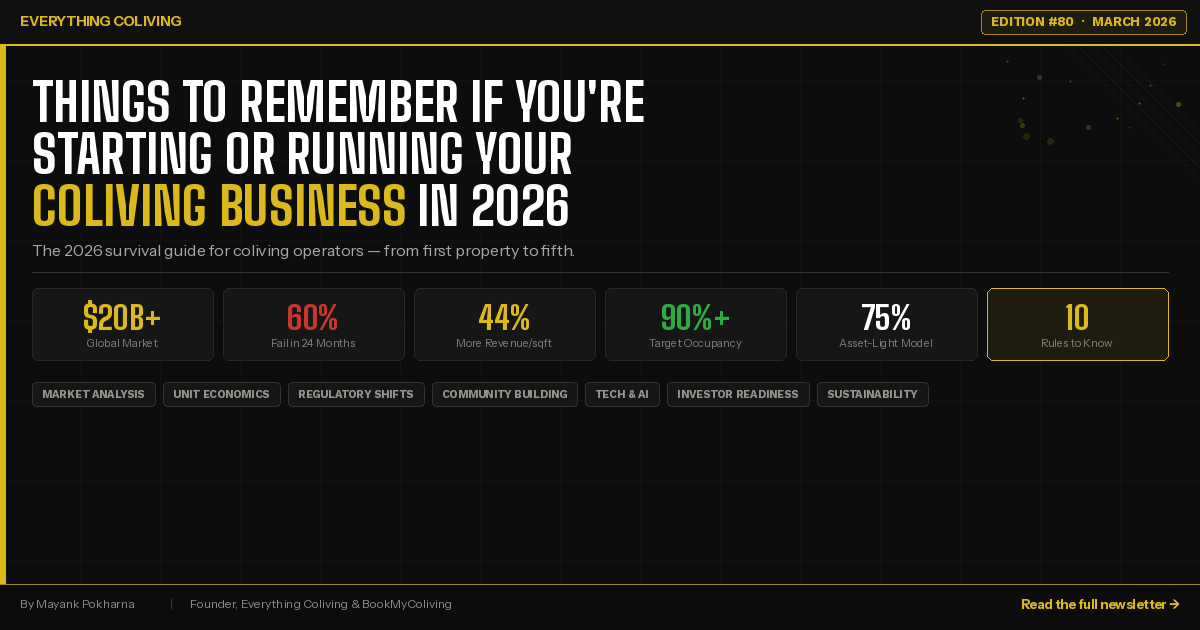
The global coliving market is approaching $20 billion with growth rates exceeding 20% annually. Savills has identified €2.6 billion of institutional capital ready to deploy in coliving. Banks now provide 27% of all coliving financing, the largest single source.
Here’s what I think: The money is here. The question is no longer if coliving works; it’s whether your coliving business is built to survive and attract this capital.
[Hard Truth #1] Over 60% of Coliving Operators Fail Within 24 Months
I wish I was exaggerating. We actually wrote about this, and the patterns are depressingly consistent:
Scaling without systems. What works with one property, the WhatsApp group, the shared spreadsheet, the founder doing everything, breaks down spectacularly at property two or three. By the time you’re managing multiple locations across different cities, you need proper property management software, standardized SOPs, and remote quality audit capabilities. Not a bigger WhatsApp group.
Poor forecasting. Income forecasts are almost always too optimistic. Costs are almost always higher than projected. Occupancy takes longer to stabilize than you think. If your financial model assumes 95% occupancy in month three, you’re building a fantasy, not a business.
Technology neglect. Founders start with spreadsheets and generic tools. By the second or third property, fragmented systems cost hundreds monthly in unused subscriptions while critical data lives in five different places.
The fix isn’t complicated; it just requires discipline.
Build your operational backbone before you need it.
[Hard Truth #2] The Ghosts of The Collective and Common Living
Two cautionary tales every coliving founder should memorize.
The Collective was once the poster child of coliving, stunning buildings, massive press coverage, and bold vision. They entered administration in 2021 after failing to find a buyer. What went wrong? They scaled before proving unit economics. Their buildings were beautiful, but the costs to deliver and operate them exceeded revenue potential. Then COVID hit. They’d secured £140 million in financing in February 2020, one month before lockdowns halted everything.
Common Living followed almost the same playbook. Filed for Chapter 7 bankruptcy in 2024 with 5,200 units across 12 US cities. Estimated $1-10 million in assets against $10-50 million in liabilities. Aggressive expansion funded by massive capital, squeezed by overhead and rising interest rates.
(And before them: Quarters. HubHaus. The pattern repeats.)
Here’s the lesson: The operators who survive are the ones who started small, proved unit-level economics, and scaled methodically. Urban Campus, the one Goldman just acquired, exemplifies this. Not the flashiest brand. Just real operations with a proven track record.
[Market Analysis] The Regulatory Landscape Is Shifting Fast
This is the one most new operators underestimate, and it can kill your business overnight.
Barcelona is ground zero. Coliving-managed properties surged 900% in five years, converting long-term residential stock into high-margin short-term units. The backlash was predictable: mass protests and a new room rental law finalized by the Catalan Parliament in December 2025, applying price caps to coliving and seasonal rentals. Barcelona en Comú is actively pushing to prohibit colivings outright. If you’re converting existing apartments in Barcelona, you’re sitting on a regulatory time bomb.
London, by contrast, is the most welcoming market. The city just greenlit over 3,000 new coliving units, including the UK’s tallest coliving tower, a 46-story building with 833 studios at Canary Wharf. Savills reports 9,000 operational units plus 5,500 under construction, with 14,000+ more at the permission stage. Nearly £1 billion in institutional investment is already deployed.
Berlin is tightening stricter, rules on shared housing, minimum unit size requirements, and strong tenancy protections. Lisbon is in a transitional period with regulatory uncertainty around tax treatment and licensing.
My take: The cities that welcome purpose-built coliving (London and parts of Spain for new construction) are where the opportunity lives. Converting existing residential stock into coliving is increasingly under threat everywhere. If your business model depends on that, it’s time to rethink.
[Deep Dive] 10 Things Every Coliving Operator Should Know in 2026
Based on everything I’ve seen, here’s my working list. Print this out. Stick it on your wall.
1. Prove Unit-Level Profitability Before Scaling
This is non-negotiable. In 2026, investors demand capital efficiency and demonstrable property-level profitability BEFORE you scale. The “grow at all costs” era is over. Show that your single property works, with occupancy above 90%, healthy NOI, and controlled operating expenses, and then replicate.
2. Go Asset-Light (Unless You Have Very Deep Pockets)
75% of coliving operators globally don’t own their properties. The most common model? Master leasing. It costs $50K-200K to launch versus $500K-5M+ for direct ownership. Trying to own and operate simultaneously is the fastest way to run out of runway.
3. Your Community Manager Is Your Most Important Hire
This person makes or breaks your space. They need to be gregarious, personable, and a natural connector who curates community event schedules and makes every new resident feel at home. The single most effective community-building event? Weekly shared meals where one person cooks for the group. Simple. Cheap. Powerful. Communities where residents feel heard have 50% higher retention rates.
4. Don’t Over-Engineer Community Programming
Here’s a counterintuitive one. Forced social programming feels inauthentic, and your residents will smell it immediately. Over 50% of operators host official events only monthly or even less frequently. The winning formula? Light structure, heavy empowerment. Give residents the tools and spaces to create their own connections. Facilitate, don’t dictate.
5. Dorm-Style Is Dead, Private Ensuites Are the Standard
The market has spoken. 50-60% of the organized industry portfolio has moved toward single occupancy units with private bathrooms. Shared bathrooms and dorm-style rooms are losing residents to operators who understand that people want community in the living room, not the bathroom.
6. Embrace Flexible Stay Lengths
The rigid 12-month lease is a relic. Successful operators in 2026 offer stays from 1 day to 1+ years, with “mid-term” stays (1-3 months) emerging as a sweet spot for remote workers. Flexible living models unlock new revenue streams and maintain higher occupancy year-round.
7. Your Lead-to-Conversion Rate Is Probably Terrible
The average operator receives 50-100 inquiries per month but converts only 15-25%. Leads go cold because of slow follow-up. In 2026, AI tools can help, but only if you set up proper systems. Dynamic pricing, automated responses, and CRM pipelines aren’t optional anymore.
8. Use Technology Thoughtfully; AI Makes Managers Better, Not Obsolete
Smart home systems reduce energy consumption by up to 30%. AI-driven pricing can optimize revenue in real time. Predictive maintenance catches problems before they become emergencies. But the most successful operators use AI as a tool to empower their community managers, not replace them. The human element is what makes coliving work.
9. Sustainability Is a Competitive Advantage, Not a Checkbox
Residents in coliving spaces use 30% less energy, 20% less water, and produce 23% less waste than traditional housing. Smart operators leverage this, green roofs as community gardens, transparent energy dashboards, and low-VOC finishes. ESG isn’t just positive ethics. It’s increasingly a requirement for institutional capital, and residents (especially younger demographics) actively choose sustainable spaces.
10. Know Your Numbers Cold
Institutional investors are coming, and they want data. The eight critical metrics you should track: RevPAB (Revenue Per Available Bed), occupancy rate (target 90%+), NOI margin (10-30% above traditional residential), cap rates (4-7%), IRR (15-25%), CAC (Customer Acquisition Cost), LTV:CAC ratio (3:1+), and DSCR (1.25x+). If you can’t rattle these off for your property, you’re not ready for institutional capital.
[Opportunity Watch] Where the Smart Money Is Going
Let me leave you with the opportunities I’m most excited about.
London remains the biggest institutional opportunity in coliving globally. With 14,000+ units at the permission stage and nearly £1 billion already deployed, the ecosystem is mature, the regulatory environment is supportive, and demand is proven.
Purpose-built coliving in Spain is attracting massive capital: Greystar, Bain Capital, Node, and now Goldman Sachs through Urban Campus. The key word is purpose-built. New construction adding to housing supply is welcomed; converting existing stock is not. If you want to attend the Spanish ecosystem, you should be attending SIMA 2026 in Madrid in May.
Senior coliving is emerging as a major new demographic opportunity. Baby boomers seeking community without homeownership burdens, combined with the loneliness epidemic, create genuine demand. The underserved segment is experiencing rapid growth.
Remote work continues to be a structural tailwind. With 52% of the global workforce now remote and hybrid job postings growing from 9% to 24% in just two years, the demand for spaces that blend work and home life is only accelerating.
Suburban and rural coliving is the emerging frontier for 2028. Larger rooms, outdoor spaces, lower density, and workation concepts, the market is expanding beyond city centers.
The Industry Has Grown Up. Have you?
Here’s the thing about 2026: the coliving industry is no longer forgiving of amateur operations. The money is bigger, the expectations are higher, and the operators who survive are the ones treating this like a real business, not a lifestyle project.
That means proper financial models. Real operational systems. Data infrastructure that institutional investors can trust. Community management that’s intentional but not forced. And unit designs that respect residents’ need for both privacy and connection.
Coliving brings in 44% more income per square foot than regular apartments and delivers an average annual ROI of 22.3% versus 8%–12% for traditional rentals. The economics work. But only if you build the foundation right.
The Goldman Sachs acquisition of Urban Campus wasn’t just a deal. It was a signal. The institutional era of coliving is here. The question is, are you ready for it?
Build well.
Mayank, Founder, Everything Coliving & BookMyColiving
If this was useful, share it with someone starting their coliving journey. And if you are keen to discover verified coliving spaces worldwide, check out BookMyColiving.com; it’s forever free. Got a coliving story, deal, or insight I should cover? Reply to this email or DM me on LinkedIn.